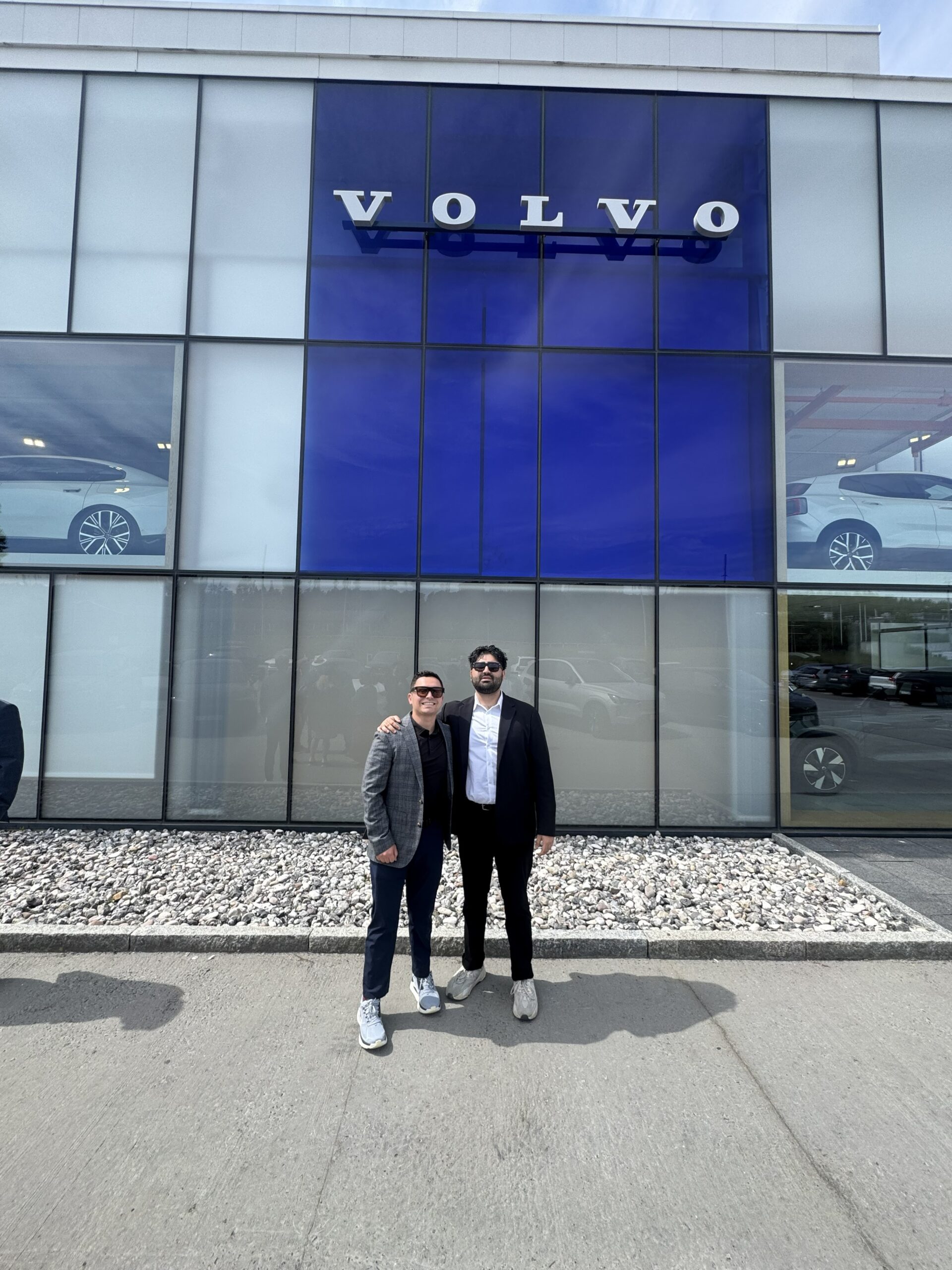
Hey everyone! Earlier this week, we had an amazing experience while visiting Volvo headquarters, or what they call the “nest.” We got to meet some lovely and smart people working at Volvo. We were impressed with one person’s presentation, specifically, Alexander’s presentation about the future of Volvo. It was quite interesting to hear that his department is named “innovation.” When we both heard that, we thought to ourselves that it was a unique department name. After hearing Alexander’s presentation, we understood why his department was named that. We were both blown away by how much Volvo is considering looking into the future of the automotive industry.
Alexander’s presentation was mainly a group discussion that started by showing which brands we, as consumers, use as a daily service. For example, we use Netflix, Uber, Airbnb, and Waymo as mobile service platforms. We use all those services by booking them via a mobile app on your smartphone. Then Alexander dove into Uber and Waymo, since both platforms use cars for their services. He then showed us some data showing us that in the future, not many people will care about owning a car. For various reasons, such as high costs to maintain a car, insurance payments, multiple car payments, and traffic, people feel like they no longer want to own a car. Instead, Alexander proposed that many consumers in the future will be using Waymo and other car service models as their main transportation. That blew our minds because we could never think of not owning a car in California. Many others in our group felt this way as well. We thought, “How could this be possible? We love owning our cars.” However, after seeing more data and conversing with Alexander, it all makes sense now, and I agree with Alexander’s statements. We could see ourselves in about 15-20 years down the road, getting rid of our cars and using Waymo to get to places. Our only concern was the availability of Waymo and other services, such as Tesla’s taxi service, being available 24/7. As of now, we think Uber takes too long to find us a driver to take us to other locations. However, Alexander claimed that Volvo and other car manufacturers will have a large fleet readily available for consumers to order at any time.
We had a few questions for Alexander about how the American market would react to this reality. As we know, Americans are less accepting of change, and this proposition by Alexander is a huge change for Americans. Americans take pride in owning items such as cars, houses, and phones, to name a few. I think other countries, such as China, Japan, and Europe in general, are more accepting of this idea, but Americans will take a long time to adapt and accept this change in the future. Another question we have for Alexander is how this will affect the production of cars. Will this increase, decrease, or keep the same amount of production of cars made per year? Also, will Volvo and other car manufacturers need to build self-driving cars like what Jaguar did with Waymo? If that happens, how will that affect the Uber driver market? All those questions will need to be figured out before implementing these new ideas.
Transitioning to the manufacturing side of Volvo, we got to go on a tour of the Volvo manufacturing plant, where we got to see the different functions of each section of the factory. Each section had multiple robots assigned to each component or task in terms of building the Volvo car. We even got to see robots driving other car parts to different sections of the factory. It’s incredible how far car manufacturing has come since the 1900’s to where it is now. While we don’t see a lot of humans working in the factories, we still see lots of humans inspecting and making sure the robots are performing to the highest level. The Volvo group leader informed us that each car built in the factory is custom-built. From a human perspective, we think that having robots build the cars, it reduces the amount of injuries and fatalities in the factory because human error is inevitable. While robots are “taking our jobs,” it’s for human safety and efficiency.
Overall, we truly enjoyed our experience at Volvo with all their new ideas coming down the road and the efficiency of how manufacturing has transformed with robots. We both were very interested in working for Volvo and even asked if they were hiring, but Volvo is in a hiring freeze. However, we are still interested in working for other automotive companies because it is an exciting industry where there are many changes in trends, and Marketing and other departments have to adapt quickly to those changes. It was a great experience, and we hope our paths cross in the future! See you all soon 🙂