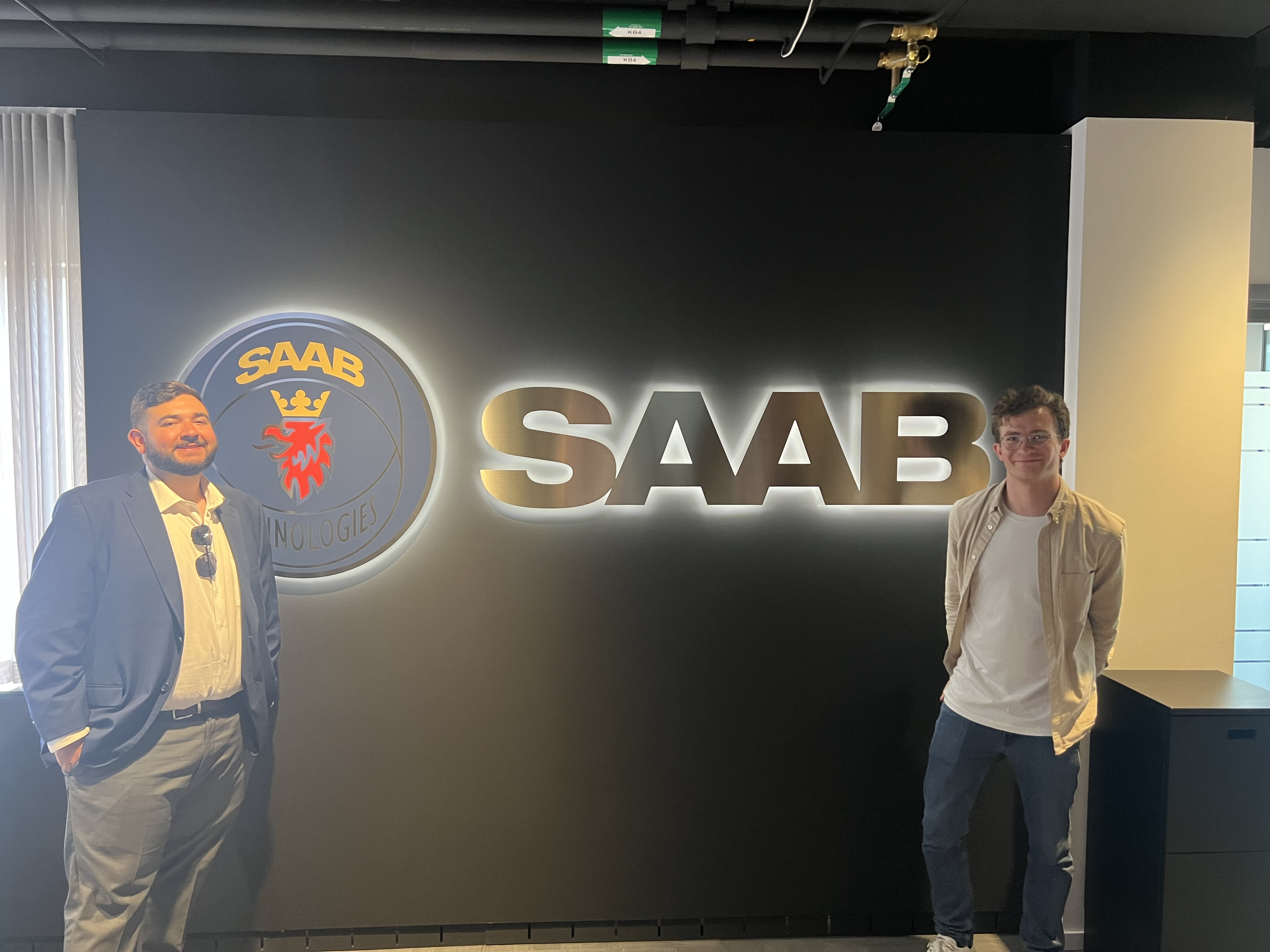
The first business we visited in Sweden’s capital city was Saab. The company began in 1937, and in the past eight decades, they have had the opportunity to construct over 5500 aircraft. Senior vice president Lars Tossman greeted us. In the showroom, we saw replicas of the military equipment they manufacture, such as the Gripen fighter jet. Political relations play a significant role in their sales and production. Specifically, the company has supplied equipment to support the Ukrainian army. Lars described the nuance of selling military equipment to other countries. Sometimes, a government may choose to source military equipment from its allies even if it may not seem practical or efficient. This was seen when the South African military asked for a compromise on jets and missiles with Saab and a French company. Government intervention also leads to where Saab can or cannot enter.
At the Spotify headquarters in Stockholm, VP of HR Anna Lundström discussed their values and her perspective as a leader in HR. Spotify values a team of innovative, passionate, collaborative, and playful people. They are constantly innovating, believing that change is constant and happens quickly. For instance, they quickly adapted to remote work when the pandemic began. Now, they offer a “work from anywhere” model, where employees can choose between an office mix and a home mix, depending on where they want to do most of their work. When Anna said that Spotify values sincerity, she meant they do not want anyone to beat around the bush. They want employees to address problems head-on and be direct with the people around them. Of course, the people at Spotify are passionate about music, but they should also be passionate about their work and the success of everybody at the company. The people at Spotify work collaboratively with engineers, who code the app and recommendation algorithms, the creatives, who make playlists and content, and the people in ad sales, who sell ad space on the free version of Spotify or ad space on podcasts. Finally, the people at Spotify are playful. Anna described a work environment where people play music and games together. In this playful spirit, they liken the company to a band, even calling their employees “band members” and their company values statement a “band manifesto.” After all, word choice can be a very effective way to foster a positive company culture. To learn more about human resources at Spotify, Anna recommends that we check out HR Works: The Podcast for Human Resources and the book BOLD by the president of HR, Katarina Berg. During our visit, Henry got to play a little piano at the Spotify HQ and warm up for karaoke the following evening.

Our final stop for the day was at challenger mode where we were greeted by founder Robel Efrem. Challengermode is on a mission to “make esports truly accessible.” They have steadily grown their business with the idea that users can create their esporting events on a simple platform that can even be streamed on popular sites such as YouTube and Twitch. While Stockholm seems to be an out-of-place location to have an esports company, Robel and his have done well for themselves as their popularity has increased to all regions of the planet. In fact, he elected to do away with his marketing team altogether, and while their tournaments are increasing, Robel still aims to keep the total number of employees to under 100. Challengermode’s success has proven that they do not need to be in a popular setting such as Los Angeles or New York to be recognized globally.