Tucked in the northern reaches of Sweden, the city of Skellefteå carries an energy that feels quietly ahead of its time. Today, our cohort visited Skellefteå University for a workshop unlike anything I had experienced in a traditional classroom setting and fittingly, that contrast became the entire point. The workshop brought together a mix of minds. My classmate Donnie and I joined forces with a marketing specialist, a journalist, and a university administrator, all united around one ambitious question: what must the future campus solve? More specifically, what does higher education look like in 50 years, and where does AI fit into that story?
We started by mapping a “Then & Now Day” which contrasts how a student moves through campus today versus how they might in 2076. The difference was striking to articulate. Today, a student wakes up, scrolls through their phone, grabs something from the cafeteria, attends lectures and seminars, and ends the night in the library (maybe). In 2076, our group envisioned a world where the morning is spent at home absorbing raw information and facts handled by AI, while the campus becomes reserved for something more irreplaceable: applying, debating, and validating that knowledge with peers in labs, seminars, and workshops. From there, we identified three major shifts driving this transformation. First, the acquisition of facts which is the cornerstone of university education and becomes obsolete in a world of high-access or high-overload information. Second, the presentation of knowledge shifts toward actually practicing skills and proving competency to employers. Third, collaboration in education becomes the mechanism for validating learning, with peers replacing professors as the primary mirror for growth.
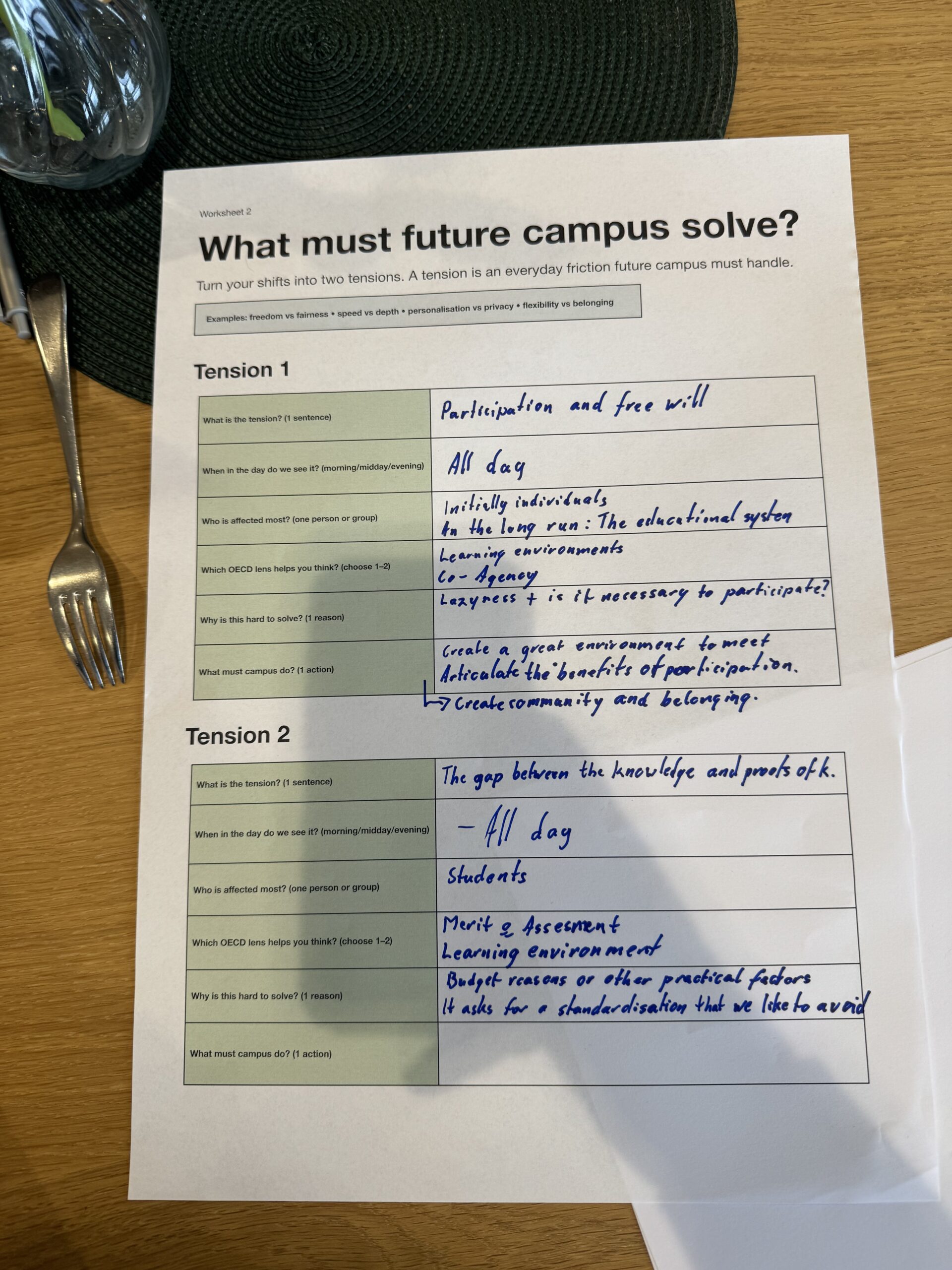
These shifts surfaced two real tensions our group wrestled with. The first was participation and free will. If campus becomes a place you choose rather than a place you must attend, how do you motivate presence? Our group landed on the idea that campuses must articulate the benefits of showing up which are creating genuine community and a belonging for the students. The second tension hit closer to home, the gap between knowledge and proof of knowledge. Students may know things deeply, but current systems struggle to certify that in flexible, individualized ways. Budget constraints and the stubborn pull of standardization make this hard to redesign.
Our prototype emerged from both tensions, a recurring, small-scale conference model where students meet weekly with industry professionals, companies, and civic actors to tackle real-world problems. A space where participation is earned, knowledge is demonstrated, and the line between student and professional begins to blur. Sitting in a room in northern Sweden with people I had never met, building something together in under two hours, felt like a prototype in itself which is proof that the future of education might already be quietly happening, one cross-disciplinary table at a time.