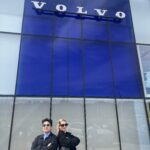
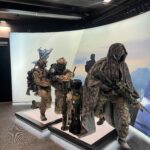
Hello, everyone! We just started day two of our business visits, and are currently trying to get some sleep on the bus. Even though it was the first day, we still had many mishaps. After one of the best inclusive breakfasts we ever had, Nikki decided to thank the hotel by breaking their paper towel holder in the bathroom. Then later that day, we were late for the bus to the World of Volvo because I realized that I lost my credit card! However I was able to find it thanks to the amazing cashier at one of Gothenburg’s really nice 7-11s where I dropped it.
Volvo
As we were given the tour through Volvo Trucks’ production facility, we couldn’t help but notice all of the employees relaxing as they did their work. They were still able to produce 60+ cabs everyday while each of them had their airpods on. Our tour guide mentioned that something she thinks is unique about the company isn’t the “jungle” they have in the middle of the warehouse, but how only one part of the process is performed by robots. In the United States we are always discussing how one day that all jobs will be replaced by robots, so I think it is interesting how they seem to be in no rush to automate. Not only are these trucks made of so many complicated parts, but they require such high quality that it is amazing that they are able to maintain this high standard without the help of robotics. But it also speaks to the customer perspective. Just like how “homemade” baked goods are considered better than others better than store bought, customers consider Volvo trucks as high quality because of the fact that they are assembled by hand.
At the same time, we didn’t think that the jungle in the middle of the factory was that surprising. We noticed that a huge part of Sweden’s work culture is their connection to nature and their care for their employees. A jungle filled with fish and palm trees that employees can relax in during their breaks is something that only an environmentally and employee friendly company would do. We even saw this connection to nature at the World of Volvo, with the location, scenery, and use of wood throughout the building.
After the factory tour we went to the office areas at Volvo where we listened to a presentation from one of the heads of social media. The social media expert explained that social media is a big part of marketing, but it has to be done right. The Volvo Group plans to consolidate their accounts so that they can better keep track of the messages that they are sending out. They grouped the accounts into global, regional, and hyperlocal to help them determine how messages should be made. All marketers know that the local culture and customs play a huge role in how a message is perceived by consumers, so having regional and hyperlocal accounts allows for the marketers to form messages that different regions and cultures will accept. She then went on to explain the importance of social media for their current employees. Swedish companies care alot about their employees, so they want to make sure that they feel like they belong and are cared for at The Volvo Group while also keeping the employees informed about important changes and events. Social media is a tool that can help them achieve those goals. Crafting the right messages on the right platforms is a much more difficult task then I would have thought. They had to do research to figure out what type of employee uses what type of platform, and then craft messages that each group of employees can understand.
The second presentation was about the Volvo Group’s strategy. Society, business, and economics change over time so the Volvo Group had to implement a strategy that adapts to these changes. For example, the modern consumer values customer service so one of The Volvo Group’s goals was to create a more customer centric business.
Saab
By the time we are finishing up this blog, day 2 has ended and we finished with our visit at Saab. Even though neither of us are exactly interested in aerospace and fighter jets, there were some aspects of the tour that stuck in our minds. Not only was it amazing to be able to see a fighter jet in person, but we were close enough to touch it.
Something else that was interesting was how just like at Volvo, Saab didn’t seem interested in automation. We got to see all the different stations where actual people were putting together these jets. Even the models were hand built. Here is a sketch of the model of Saab’s Gripen fighter jet that we saw in the conference room, drawn by Ritika…

I’m interested to see if this is a coincidence that the two companies we visited didn’t care much for automating their production, or if it is part of Swedish culture